- Vorschau
- Neuerscheinungen
-
Reihen / Zeitschriften
- Österreich
-
Türkei
- Acta Classica Mediterranea
- Actual Archaology Magazine
- Adalya
- Aigai
- AKMED Series
- AKRON
- Anadolu / Anatolia
- Anatolia Antiqua
- Anatolian Civilizations Series
- Anadolu ve Çevresinde Ortaçağ
- APAD
- Archivum Anatolicum
- Arkeoloji Dergisi
- BYZAS
- Cedrus
- Colloquium Anatolicum
- Eskıçağ Yazıları
- Gephyra
- Hadrianopolis
- Hierapolis di Frigia
- Journal of Mosaic Research
- Kairos. Anatolian Numismatic Studies
- Kilikia Arkeolojisini Araştırma Merkezi
- Kültepe tabletleri
- Laodikeia Çalışmaları
- Miras
- OLBA
- Parion Studies
- Philia
- Selevceia ad Calycadnum
- Smintheion Studies
- Stratonikeia Çalışmaları
- Studies on the Troad / Troia Vakfı Yayınları
- Sylloge Nummorum Graecorum
- Tarsus Araştırmaları
- Tripolis ad Maeandrum
- TÜBA - AR
- Valonia
- Yerleşim Arkeolojisi Serisi / Settlement Archaeology Series
- Tschechien
- Ungarn
- Rumänien
- Deutschland
- diverse Reihen
- Slowenien
- Systematik
- Kunsthistorisches Museum Wien
- Naturhistorisches Museum Wien
- Stadtarchäologie Wien
- Stadtmuseum St. Pölten
- Bildbände
- Viennensia
- Führer
- Ausstellungskataloge
- Antiquariat
- Abverkauf
- Festschriften
- E-Books
- Newsletterarchiv
Produkte filtern
Anatolia Antiqua XXIII (2025)Istanbul 2025ISBN 9771018194005283 S./pp., zahlr. S/W-Abb. / num. b/w-figs., 27,5 x 19,5 cm; broschiert / softcover Table of Contents; Estelle Galbois – Isabelle Hasselin RousTransferts techniques, iconographiques et culturels entre l'Égypte et la cité de Tarse (Cilicie) : l'exemple des figurines de terre cuite. Remarques préliminaires Kerry Hull – Lincoln H. BlumellHekate and the Priest Dionysios on a Phrygian Doorstone Monument in the North Carolina Museum of Art Ergül Kodaş – Mehmet Şan – Charlotte Labedan-KodaşDes statues néolithiques à l'est de Şanlıurfa (province de Mardin, Turquie) CHRONIQUES DES TRAVAUX ARCHÉOLOGIQUES EN TURQUIE 2024 Olivier Henry – İpek Dağlı Henry – Emmanuelle Vila – Alina Streinu – Vasilica Lungu – Elisabeth Goussard – Alexandre Rabot – Şeyda Çakmak – Agathe Petit – Görkem Çimen – Jeanne Capelle – Baptiste Vergnaud – Malgorzata KajzerLabraunda 2024 : Rapport préliminaire Éric Jean – Martin Sauvage – İ. Murat Özulu – Alice Mouton – Alessio Mantovan – Matteo FolettiPorsuk Höyük 2024 : Rapport préliminaire Martin Seyer – Burak Orakçılar – Philip M. Bes – Ioana M. Potra – Gerhard Forstenpointner – Nikolaus Schindel – Ursula Quatember – Julia Vogel – Andrew K. Y. Leung – Anna-Maria Tupy – Susanne Leiner – Zeynep Kuban – Bilge Ar – Umut Almaç – Öykü Balcı – Görkem GünayThe Excavation and Research Works at Limyra (Lycia) 2024: Preliminary Report Banu Özdilek – H. Onur Tıbıkoğlu – Ali ÇoblikayArchitectural and Urban Insights from the 2024 Excavations: The Podium Temple, Port Catabolos, and Waterways of Issos Epiphaneia Armin Bergmeier – Ayşe Ercan Kydonakis – Alessandra RicciMapping Transformations in Central Anatolia: Interim Report of the Second Season of the Museum Survey Project in Akşehir/Philomelion (2024 Season) Asil Yaman – Koray Konuk – Anna M. Sitz – İlayda Alikaya – Taylan Doğan – Erkan Dündar – M. Rumeysa Çakan – Aslıhan Güçlü – Ayşe Özaydın – Kübra Günbey – Bahar Çitez – Güneş Anlıak – Şeyda Sayın – Aleyna Uyanık – Elif Sokullu – Hilal Demirhan – M. Serhat AydemirPreliminary Report on the 2024 Fieldwork at Phoenix Çiğdem Maner – Emre Kuruçayırlı – Zerrin Mutlu – Alper Bıçakçı – Daniel Bolitho – Mete Fırat Buyruk – Fatma Arzu Demirel – Yavuz Selim Güler – Claudia D'Orazio – Hasan Peker – Fırat Piraloğlu – Özgü Çömezoğlu UzbekThe Excavation at Kayalıpınar-Samuha 2024: A Preliminary Report
Mehmet Önder,Aigai Sikkeleri. 2004 - 2016 Buluntuları (Aigai II)Istanbul 2026ISBN 978-625-6212-58-9275 S./pp., zahlr. S/W-Abb. / num. b/w-figs., 27,5 x 19,5 cm; broschiert/softcoverWährend der ersten 13 Grabungskampagnen in Aigai (2004–2016) wurden 1520 Münzen dokumentiert. Davon sind 400 aufgrund von Beschädigungen in sehr schlechtem Zustand. Die verbleibenden 1120 Münzen sind in dieser Studie enthalten, die von dem Archäologen Mehmet Önder kurz vor seinem Ruhestand abgeschlossen wurde. Önder war Mitglied des Ausgrabungsteams von Aigai und führte numismatische Untersuchungen durch. Der Katalogteil des Buches enthält Fotografien aller Münzen, detaillierte Informationen und Maße sowie alle verfügbaren Quellenangaben. Die Münzen sind in die Kategorien „Griechisch“, „Römisch“, „Byzantinisch“ und „Unbekannt“ unterteilt. Griechische Münzen werden chronologisch nach Region und Stadt präsentiert. Römische Kaisermünzen und byzantinische Münzen sind chronologisch nach Kaiser, Münzstätte, Einheit und Prägejahr gruppiert. Griechische und römische Münzen, die unter der Überschrift „Unidentifiziert“ kategorisiert wurden, wurden nach den Teilinformationen, die sie liefern, gruppiert und nach ihren möglichen Datierungen geordnet. Die Kapitel des Buches mit den Titeln „Münzprägung in Aigai“, „Liste der Herrschernamen auf Aigai-Münzen“ und „Römische Kaiser und Familienmitglieder, deren Namen in Aigai geprägt wurden“ basieren auf den ausgegrabenen Münzen und weiteren Quellen. Die Beschreibungen und statistischen Informationen der geborgenen Münzen finden sich unter den Überschriften „Herkunft, Merkmale und Anzahl der geborgenen Münzen“, „Geborgene Münzen aus Aigai“, „Gefundene Münzen insgesamt“, „Liste der römischen Kaiser und Familienmitglieder, deren Münzen geborgen wurden, und Münznummern“, „Liste der römischen Kaiser und Familienmitglieder, deren Münzen geborgen wurden, und Münzkatalognummern“ sowie „Schlussfolgerung“.
Kairos. Anatolian Numismatic Studies 3/2025Istanbul 2025ISSN 3023-7068IV + 139 S./pp., zahlr. S/W-Abb. / num. b/w-figs., 27,5 x 19,5 cm; broschiert / softcover İÇİNDEKİLERSilver Coinage of Seleucus II Callinicus from Asia Minor: Production and Circulation / II. Seleukos Kallinikos'un Küçük Asya Gümüş Sikkeleri: Darp ve SirkülasyonBarbara Zając,Isis vs. Sarapis: Egyptian Cults on the Coins of Pontus and Bithynia in the Roman Period / Isis vs. Sarapis: Roma Döneminde Pontos ve Bithynia Sikkelerinde Mısır KültleriZeynep Çizmeli-Öğün – Marie-Christine Marcellesi, Le Trésor de Monnaies Romaines Tardives Trouvé dans une Tombe du Letoon près de Xanthos en Lycie / Xanthos Yakınlarındaki Letoon'da Bir Mezarda Ele Geçen Geç Roma Sikkeleri DefinesiS. Ranucci – S. Casciarri – V. Chiaraluce – L. Donnini – M. Gasperini,Monete Romane Provinciali dalla Via Flaminia a Carsulae, Vecchi Ritrovamenti e Recenti Acquisizioni / Via Flaminia'dan Carsulae'ye Roma Eyalet Sikkeleri: Eski Buluntular ve Yeni KazanımlarYannis Stoyas,The Emperor and the Prophet: An Extraordinary Basilikon Issue of Andronikos II Palaiologos with the Prophet-King Solomon / İmparator ve Peygamber: Andronikos II Palaiologos'un Peygamber-Kral Süleyman Tasvirli Olağanüstü Bir Basilikon DarbıShort NoteDinçer Savaş Lenger,Reattribution of a Bronze Coin to Larissa in Aiolis / Bir Bronz Sikkenin Aiolis'teki Larissa'ya Yeniden AtfıSalvage ExcavationŞahan Kırçın – Merve Kaya Köroğlu,Coin Finds from Salvage Excavations in Turkey: Hasköy (Havsa–Edirne) / Türkiye'deki Kurtarma Kazılarında Ele Geçen Sikkeler: Hasköy (Havsa–Edirne)Koray Konuk – Burcu Dama,Numismatica Turcica 2024: A Review of Numismatic Publications in Turkish
Emel Erten – Diane Favro – Fikret K. Yegül – Murat Özyıldırım (eds.), Selevcia Ad Calycadnum XVI/2026Ankara 2026ISBN 978-625-8550-34-4ISSN 2148-4124366 S./pp., zahlr. S/W-Abb./num. b/w-figs., 24 x 17 cm; broschiert/softcover
Askold Ivantchik – Vedat Keleş – Roman Stoyanov (eds.),Agora I. Byzantine House in the Agora Area (Parion Studies X)Istanbul 2026ISBN 978-625-6212-55-8VIII + 340 S./pp., zahlr. Farb- und S/W-Abb./num. colour and b/w-figs., 29,7 x 21,5 cm; kartoniert/hardcoverdreisprachig türkisch – englisch – russischtrilingual turkish – english – russian
Valonia. A Journal of Anatolian Pasts 2 (2025)Istanbul 2025ISSN 3062-0120VI + 98 S./pp., zahlr. Farb-Abb. / num. colour figs., 26 x 19 cm; broschiert / softcover
Ersin Çelikbaş – Rabia Aktaş (eds.),Hadrianopolis. Building Complex with Bath Storage Finds / Hamamlı Yapı Kompleksi: Depo buluntuları(Hadrianopolis Serisi/Series III)Ankara 2025 ISBN 978-625-8550-08-5X + 129 S./pp., zahlr. Farb- und S/W-Abb./num. colour and b/w-figs., 29,7 x 21 cm; kartoniert/hardcoverDas Buch mit dem Titel „Hadrianopolis Bath Building Complex: Warehouse Finds“ handelt von den Funden, die bis heute im Lagerbereich des Hamamlı-Gebäudekomplexes erhalten geblieben sind, als Ergebnis der zwischen 2023 und 2025 durchgeführten Ausgrabungen in Hadrianopolis.
Philia. International Journal of Ancient Mediterranean Studies. 11, 2025Wien 2025ISSN 2149-505XISBN 978-3-85161-332-2240 S./pp., zahlr. S/W-Abb./num. b/w-figs., 29,7 x 21 cm; kartoniert / hardcover
Gephyra 30, 2025Wien 2025ISBN 978-3-85161-333-9ISSN 1309-3924220 S./pp., zahlr. S/W-Abb./num. b/w-figs., 29,7 x 21 cm; broschiert/softcover
Nihat Tekdemir (ed.),Script to Art, Faith to Thought – A Compendium of Anatolian CivilizationsIstanbul 2025ISBN 978-975-08-6623-4 (paperback) ISBN 978-975-08-6624-1 (hardcover) XX + 396 S./pp., zahlr. Farb- und S/W-Abb./num. colour and b/w-figs., 33 x 23,5 cmzweisprachig englisch – türkischbilingual english – turkish
TÜBA - AR 36Türkiye Bilimler Akademisi Arkeoloji Dergisi 36, 2025Ankara 2025ISSN 1301-8566192 S./pp., zahlr. Farb- und S/W-Abb./num. colour and b/w-figs., 29,7 x 21 cm, broschiert/softcoverArtikel in Türkisch und Englisch / articles in turkish and english
Emel Erten – Diane Favro – Fikret K. Yegül – Murat Özyıldırım (eds.), Selevcia Ad Calycadnum XV/2025Ankara 2025ISBN 978-625-6925-83-0ISSN 2148-4124409 S./pp., zahlr. S/W-Abb./num. b/w-figs., 24 x 17 cm; broschiert/softcover
Alper Yılmaz – Cevat Başaran – Hasan Kasapoğlu – Kasım Oyarçin – Vedat Keleş (eds.),Parion Kazıları 20. Yıl Armağanı(Parion Studies IX)Istanbul 2025ISBN 978-625-6212-14-5X + 400 S./pp., zahlr. Farb- und S/W-Abb./num. colour and b/w-figs., 29,7 x 21,5 cm; kartoniert/hardcover
Kairos. Anatolian Numismatic Studies 2/2024Istanbul 2024ISSN 3023-7068IV + 143 S./pp., zahlr. S/W-Abb. / num. b/w-figs., 27,5 x 19,5 cm; broschiert / softcover
Gephyra 29, 2025Wien 2025ISBN 978-3-85161-325-4ISSN 1309-3924203 S./pp., zahlr. S/W-Abb./num. b/w-figs., 29,7 x 21 cm; broschiert/softcover
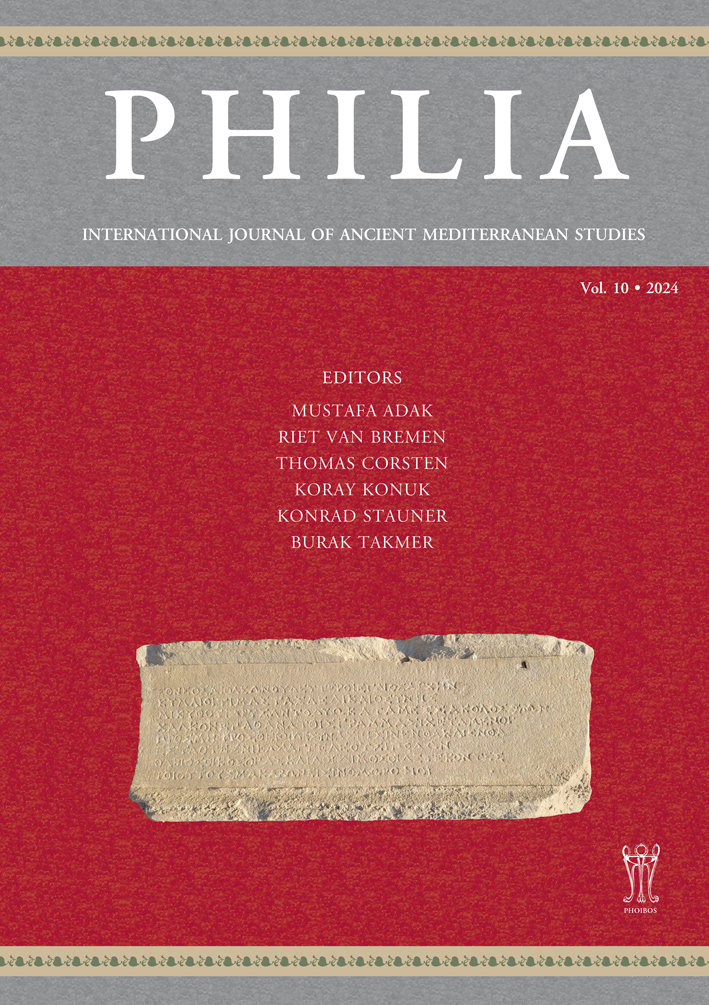
Valonia. A Journal of Anatolian Pasts 1 (2024)Special IssueByzantine Cappadocia:Current Research and Emerging Issuesedited by Robert G. Ousterhout and Tolga B. UyarIstanbul 2024ISSN 3062-0120216 S./pp., zahlr. Farb-Abb. / num. colour figs., 26 x 19 cm; broschiert / softcover
Anatolia Antiqua 32 (2024)Numéro Spécial: Anatolian LandscapesIstanbul 2024ISBN 978-2-36245-089-1ISSN 1018-1946VIII + 446 S./pp., zahlr. S/W-Abb. / num. b/w-figs., 27,5 x 19,5 cm; broschiert / softcover
TÜBA - AR 35Türkiye Bilimler Akademisi Arkeoloji Dergisi 35, 2024Ankara 2024ISSN 1301-8566228 S./pp., zahlr. Farb- und S/W-Abb./num. colour and b/w-figs., 29,7 x 21 cm, broschiert/softcoverArtikel in Türkisch und Englisch
Emel Dereboylu Poulain,Aigai Figürinleri(Aigai III)Istanbul 2024ISBN 978-625-6212-01-5XII + 361 S./pp., zahlr. S/W-Abb. / num. b/w-figs., 27,5 x 19,5 cm; broschiert/softcover At the end of the 19th century the eyes are turned towards Myrina in the area of Aeolis, because of thousands of terra cotta figurines laid out in tombs of its necropolis. The necropolis of Myrina thus became the antique site most important, whereas research on the close sites, were somewhat forgotten. Today, of new excavations in the area of Aeolis help us has to understand the art of the coroplaste, which until was now limited only has Myrina. The ville of Aegae, located in this area, or of the French archaeologists had discovered a small number of figurines in 1882, was the object during many years of plunderings of figurines, in particular in years 1950-1960. Certain villagers tell that their fathers and grandfathers had put at the day during this same time, of the painted figurines of big size, then sold to the American soldiers. To date, one still does not know what became the catch figurines. The excavations and the research currently undertaken in the town of Aegae put at the day of many figurines of great quality representing various subjects. These many discoveries, seem to confirm the importance of the art of the coroplastie of Aegae. We have a larger pallet of examples which show than the production of terra cotta was very developed and very active in Aegae. It does not remain about it less than it is necessary for us to find the workshops in order to be able to prove that in due form. The majority of works are dated from the hellenistic period. Especially with 2nd century before J-C, the production out of the city would have increased. It is not only the case for Aegae but also for the other cities of Anatolia Western. Works of Aegae are witnesses of enrichissement of art coroplaste in Anatolia Western during these centuries. We suppose that these terracotta figurines were produced in the city. Indeed, works discovered reflect the marked taste of the coroplastie, the concern nuns of the inhabitants to create figurines and plates representing the Gods and the Goddesses. The figurines with the religious motif discovered in votive pits of the building of Bouleuterion, reflect ritual inhabitants.
Philia. International Journal of Ancient Mediterranean Studies. 10, 2024Wien 2024ISSN 2149-505XISBN 978-3-85161-319-3262 S./pp., zahlr. S/W-Abb./num. b/w-figs., 29,7 x 21 cm; kartoniert / hardcover
Archivum Anatolicum 18/1Ankara 2024ISSN 1300-6355268 S./pp., S/W-Abb. / b/w-figs., 23,5 x 16 cm; broschiert/softcover
Ersin Çelikbaş – Ercan Verim, Hadrianopolis Kuzeybati Nekropol Kilisesi(Hadrianopolis Serisi/Series II)Ankara 2024ISBN 978-625-6925-65-6 VIII + 209 S., zahlr. Farb- und S/W-Abb./num. colour and b/w-figs., 29,7 x 21 cm; kartoniert/hardcover
Kairos. Anatolian Numismatic Studies 1/2023Istanbul 2023ISSN 3023-7068XII + 162 S./pp., zahlr. S/W-Abb. / num. b/w-figs., 27,5 x 19,5 cm; broschiert / softcover
Erdoğan Aslan – Yusuf Kılıç – Uğurcan Orhan – L. Ufuk Erdoğan,A Polichnion in Lycia: Kekova Island. Research Results ASMS (AKMED Series in Mediterranean Studies) 6 Istanbul 2024ISBN 978-625-98205-7-6XVI + 458 S./pp., zahlr. Farb- und S/W-Abb. / num. colour and b/w-figs., 4 Pläne/plans, 28 x 21 cm; kartoniert/hardcover Die Insel Kekova, die der Region, in der sie liegt, ihren Namen gibt, befindet sich in der Region zwischen dem Bezirk Demre der Provinz Antalya und dem Bezirk Kaş, 1 km vom Festland entfernt. Die Insel liegt an der alten Mittelmeerhandelsroute und ist etwa 7 km lang und 1,6 km breit. Auf der Insel Kekova hat es in jüngster Zeit keine Besiedlung gegeben. Da die Region sowohl eine archäologische Stätte als auch ein besonderes Umweltschutzgebiet ist, sind die alten Siedlungen auf der Insel gut erhalten. Obwohl sie heute vor menschlicher Zerstörung geschützt ist, sind die zerstörerischen Auswirkungen der Erdbeben, von denen die Region in der Antike betroffen war, vor allem in den Küstengebieten der Insel zu beobachten. Infolgedessen stehen die Hafenbereiche und Küstenstrukturen der antiken Küstensiedlungen in der Region Kekova heute etwa zwei Meter unter Wasser. Auf der Insel, die bisher noch nicht zur Gänze wissenschaftlich erforscht wurde, wurden bei Unterwassersurveys eine Kirche/Kloster, sechs Kirchen, fünf Kapellen, zwei Bäder, fünf Fischsaucenwerkstätten, fünf Wein-/Olivenölwerkstätten, 260 Häuser, zwei Turmfarmen, 107 Zisternen, fünf Kalksteinbrüche, drei Häfen, zwei Ankerplätze und 13 Anlegestellen in allen drei Siedlungen im Charakter von Küsteninselsiedlungen, sieben Wrackfunde und 45 verschiedene Amphorentypen dokumentiert. Die Insel und ihre Küsten weisen hinsichtlich der architektonischen Strukturen eine Reihe von Funden zwischen dem 4. Jh. v. Chr. und der frühen oströmischen Zeit auf, während die bei den Unterwassersurveys identifizierten Amphorenfunde einen Zeitraum zwischen dem 8. Jhdt. v. Chr. und dem 13. Jhdt. n. Chr. abdecken.